


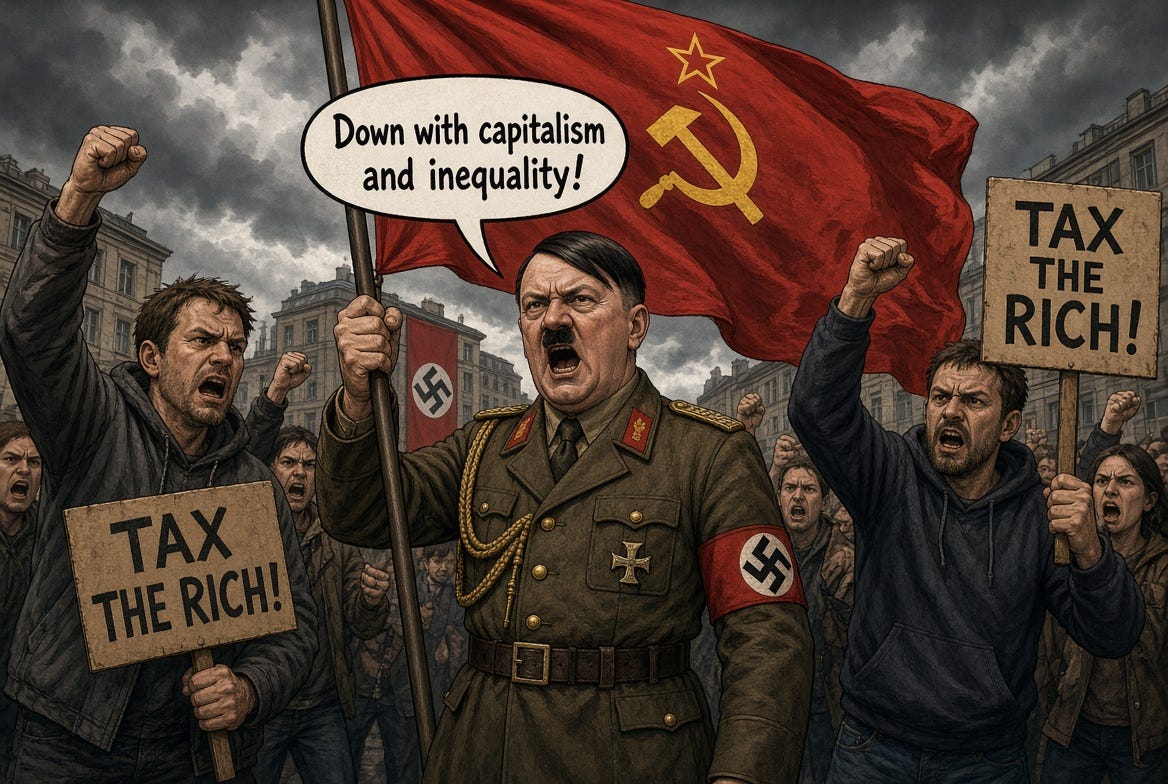
In various speeches, Hitler echoed Marxist rhetoric explicitly calling for the elimination of economic classes.
“What they hate is the Germany which sets a dangerous example for them, this social Germany. It is the Germany of a social labor legislation which they already hated before the World War and which they still hate today. It is the Germany of social welfare, of social equality, of the elimination of class differences—this is what they hate!” - Hitler 1939 speech
“And we want that you, German boys and girls, to absorb everything that we wish for Germany. We want to be one people and through you, to become this people. We want a society with neither castes nor ranks and you must not allow these ideas to grow within you.” - Triumph of the Will (1934)
“All the more so after the war, the German National Socialist state, which pursued this goal from the beginning, will tirelessly work for the realization of a program that will ultimately lead to a complete elimination of class differences and to the creation of a true socialist community.” - Speech for the Heroes’ Memorial Day (1943)
“Sickle and hammer were once the symbols of the German peasant and the German worker. The arrogance and lack of reason of a bourgeois age abandoned and lost these symbols. ... The National Socialist State will overcome this ill-fated development. The hammer will once more become the symbol of the German worker and the sickle the sign of the German peasant.” - May 1, 1934, May Day speech in Berlin
When the prospect of an alliance with England was shattered, Hitler rhetorically shifted from “Nordic solidarity” to global class warfare using the traditional Marxist categories. Professor Brendan Simms noted:
“Now that he had given up all hopes of a British alliance, and of accommodation with Anglo-America, his language shifted from that of Nordic solidarity to that of a global class conflict in which he substituted nations for the classic Marxist social categories. The United States and the British Empire, on this reading, were the “haves”, the lords of all they surveyed. The Germans, by contrast, were firmly among the “have-nots”, ground down by the forces of “plutocracy”, which were determined to extirpate the contagious social model of the Nazi Volksstaat.”
Hitler was a classical resentful pauper who emerged from the lower classes. His disdain for elites and the wealthy carried through his entire rule, using all his power to dispossess wealthy businessmen of their possessions to “redistribute” it to both himself and his cronies and less well off Germans.
His entire political project was underscored with mass theft: first from wealthy Germans and Jews and then from all the ethnic groups (Czechs, Poles, Russians, French, Greeks, etc) that Germany conquered militarily, looting and pillaging their nations and sucking them dry of food, art, gold, furniture, minerals, oil, land, etc.
Like all major socialists, Hitler was an unrepentant hypocrite who refused to pay taxes on his extensive earnings from the sale of Mein Kampf and shut down the case against him at the tax office when he got into power.